
PEG-MGF
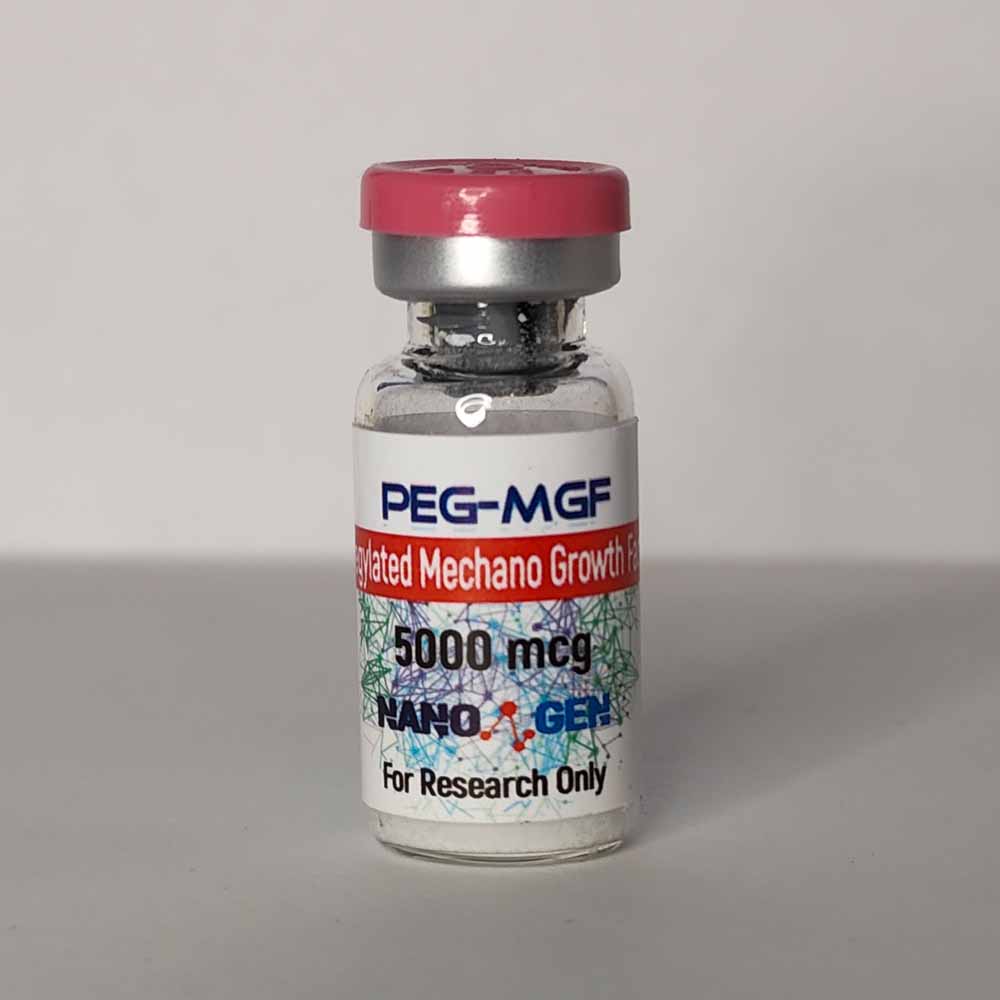
PEG-MGF: detailed description, properties, characteristics and research directions
PEG-MGF is an experimental peptide that is often discussed in connection with muscle tissue recovery, adaptation to physical load and regenerative biology. On the internet it is frequently presented in an overly simplified way, as if it were a fully studied substance with clear and guaranteed effects. In reality, the situation is much more complex. PEG-MGF is primarily interesting as a research molecule associated with local tissue repair and the cellular response to mechanical stress.
To understand what PEG-MGF is, it is first necessary to look at its foundation. MGF stands for Mechano Growth Factor. It is usually described as a variant connected with the IGF-1 system, which is involved in growth, adaptation and tissue regeneration. Put simply, MGF is associated with the body's response to mechanical stress: intense physical effort, microdamage in muscle tissue and the need to activate repair processes.
How PEG-MGF appeared
Interest in MGF emerged when researchers began to study how muscle tissue responds to overload and injury. It became clear that under such stress not only general growth factors are activated, but also more local signals directly related to repair and adaptation. Because of this, MGF began to be viewed as one of these local biological signals.
Later, the idea appeared to modify MGF so that it could remain stable in the body or in an experimental system for a longer time. This is how PEG-MGF emerged. The prefix PEG means that polyethylene glycol was attached to the molecule. This approach is called pegylation. In biochemistry and pharmacology it is used to change the properties of a molecule: to improve stability, slow degradation, extend circulation time and make a substance more suitable for experimental use.
For this reason, PEG-MGF is not a natural molecule in its pure form, but a modified variant created in order to obtain a more stable form of a signal associated with regenerative processes.
What MGF is in simple words
Without complicated terminology, MGF can be described as one of the biological signals associated with the way tissues respond to load. When a muscle is exposed to mechanical stress, adaptation processes begin. The body does not respond only with fatigue. It also starts to remodel tissue, repair damaged areas and increase readiness for the next load. In this context, MGF became interesting as part of a complex tissue response system.
It is important to understand that MGF should not be seen as a universal solution for every goal. It is not a "growth switch" and not a simple mechanism that instantly triggers hypertrophy. It is a finely regulated biological process that depends on tissue condition, timing, dosage, molecular form and many other factors.
How PEG-MGF differs from regular MGF
The key difference is the presence of the pegylated component. Pegylation changes how the molecule behaves: it may degrade more slowly, stay in circulation longer and show different pharmacokinetics compared with the native form. This is exactly what made PEG-MGF especially popular in discussions related to sport and recovery.
The basic logic is simple: if a natural repair signal exists but acts only for a short time, researchers try to make it more stable. From this comes the idea of a longer-lasting action. However, this approach also has another side. A modified molecule does not behave exactly like the natural version. Changing stability almost always affects other properties as well, which is why PEG-MGF cannot automatically be treated as simply a "stronger MGF."
Main properties of PEG-MGF
When people talk about PEG-MGF, they usually mean the following assumed properties:
- connection with tissue recovery processes after mechanical load;
- interest for the study of muscle adaptation and regeneration;
- potential influence on cellular processes related to growth and repair;
- greater stability compared with non-pegylated short-lived forms;
- interest in tissue engineering and regenerative research.
At the same time, it is important to keep an honest scientific perspective. Many claims about PEG-MGF on the internet sound far more confident than the real data allow. There is genuine scientific interest in this molecule, but the high-quality evidence base regarding its use in humans is very limited. Because of that, it is more accurate to speak not about proven effects, but about research directions and biological logic that make this peptide interesting to science.
Characteristics of PEG-MGF
PEG-MGF is usually described as a synthetic peptide construct connected with MGF and supplemented with a PEG component in order to improve stability. In both popular and research-oriented discussions, several key characteristics are commonly attributed to it.
- Origin: a derived variant associated with MGF and the IGF-1 system.
- Type: an experimental peptide construct.
- Special feature: the presence of a PEG component that affects stability and circulation.
- Biological interest: muscle recovery, cellular adaptation and regenerative processes.
- Status: a research substance, not a universally accepted clinical drug.
These characteristics matter because they immediately separate a scientific approach from marketing promises. PEG-MGF is interesting as an object of study, but it should not be placed on the same level as well-studied and officially approved medicines.
Why PEG-MGF became known in the sports environment
The sports world became interested in PEG-MGF for a simple reason: everything related to muscle recovery and adaptation to training load always attracts attention from athletes. The logic seemed attractive. If MGF is connected with the muscle response to mechanical damage and regeneration, and PEG-MGF may be more stable, then it becomes easy to imagine that this form could maintain the recovery signal for a longer period.
On this basis, PEG-MGF began to be actively discussed in the context of strength sports, bodybuilding and sports pharmacology. The problem is that the popularity of this substance in the sports world grew faster than the high-quality evidence behind it. In practice, this means there is a significant distance between an interesting theory and truly confirmed effectiveness.
Research on use in sport
The studies most often mentioned in discussions about PEG-MGF usually concern not PEG-MGF itself as a well-studied substance in humans, but the broader topic of MGF, IGF-1 variants and certain peptide fragments associated with muscle tissue regeneration. In the scientific literature, researchers have discussed possible effects on the proliferation of cells involved in muscle repair, as well as influences on adaptation processes after damage.
Particular attention has been given to so-called satellite cells, meaning muscle stem cells that participate in the repair and renewal of muscle fibers. The idea was that MGF-like signals might be associated with the activation of mechanisms that help tissue recover after overload. This specific aspect made the topic especially attractive for sport.
At the same time, this needs to be stated clearly: the scientific data are not uniform. In some studies, MGF-related signals looked promising, while in others the picture was much less clear. This is important because the internet often presents a very simple model to readers: "there is a peptide, so muscles grow." Real biology is much more complex. Even if a molecule participates in a regenerative response, that does not automatically mean a direct, stable and guaranteed effect under real sports conditions.
PEG-MGF and the anti-doping context
The topic of PEG-MGF is also closely linked to the anti-doping field. All substances that belong to growth factors, signaling peptides or potential modulators of tissue recovery attract increased attention from sports regulatory bodies. This is not only about effectiveness, but also about the possibility of misuse in competitive sport.
Because of that, discussion of PEG-MGF in sport almost always goes beyond ordinary physiology. It brings together sports biology, ethics, regulation and safety. For the average user, the most important point is simple: popularity in sport does not mean a substance is well studied, safe and suitable for practical use.
Interest in PEG-MGF in other fields
Although PEG-MGF is most often associated with sport on the internet, science looks at the topic much more broadly. The main area of interest is regenerative biomedicine. Researchers are attracted by the idea of a controllable recovery signal that could act not only in muscles, but also in other tissues.
1. Cardiology and heart recovery
One of the most interesting directions is the study of MGF-like signals in the context of cardiac tissue. In experimental models, such peptide domains have been considered potentially useful for protecting myocardial cells after ischemic damage. This area is especially important because the heart tolerates hypoxia poorly and depends on finely tuned cellular protection and repair mechanisms.
From this perspective, the idea emerged that such molecules should be studied not as "sports supplements," but as tools for regenerative therapy and local signal delivery to damaged areas. This is already a completely different level of interest: not fitness or marketing, but tissue biology and regenerative medicine.
2. Cartilage tissue and joints
Another promising direction involves cartilage tissue. Cartilage regenerates slowly, and in the presence of degenerative changes, inflammation or chronic overload, recovery becomes even more difficult. For this reason, researchers study molecules that might support cellular activity, migration and the survival of chondrocytes.
PEG-MGF and related MGF-oriented research are interesting here not as ready-made solutions, but as part of a broader strategy: how to support cells in damaged tissue and improve the microenvironment that favors regeneration.
3. Bone tissue
In biomedical research and tissue engineering, a possible role of MGF-like signals in bone regeneration is also discussed. Here attention is focused on cell proliferation, tissue remodeling and the interaction of biological signals with cells involved in bone formation. For science, this is an important topic because healing bone defects requires the coordinated work of many biological mechanisms.
4. Tendons and soft tissues
Tendons and other dense connective tissue structures are also among the potentially interesting areas. These tissues are constantly exposed to mechanical load, and recovery after injury takes a long time. In this context, interest in mechano-sensitive growth factors appears logical: if tissue responds to tension, researchers want to understand whether adaptation and repair signals can be influenced in a targeted way.
5. Nervous tissue
Some research lines have also touched on the neuroprotective properties of domains connected with MGF. This is especially interesting because it shows that the topic has long gone beyond purely muscle biology. In the context of neurobiology, such interest is related to cell survival, protection from damage and the response of tissues to stressful conditions.
Why PEG-MGF should not be overestimated
The biggest mistake in many popular materials about PEG-MGF is confusing scientific interest with ready-made promises. On the internet, the substance is often presented almost as an already proven way to accelerate muscle growth, improve recovery or increase sports performance. That kind of presentation may work well for marketing, but it poorly reflects the real level of evidence.
A scientific approach requires separating three different things:
- biological plausibility;
- results of preclinical research;
- clinically confirmed effectiveness in humans.
PEG-MGF currently has interesting biological logic and clear scientific appeal. But that still does not mean there is a complete clinical basis strong enough to support firm and categorical conclusions.
Strengths of scientific interest in PEG-MGF
Despite its limitations, the PEG-MGF topic has several strong sides. These are exactly the reasons why researchers continue to pay attention to it.
- It is connected with a fundamental area: tissue regeneration after mechanical stress.
- It helps researchers better understand how cells respond to damage and initiate repair processes.
- It is interesting for tissue engineering, where local growth and survival signals are highly important.
- It may serve as a useful model for a better understanding of the broader IGF-1 system and its variants.
- It helps define the boundary between physiological recovery and pharmacological intervention more clearly.
Limitations and controversial points
At the same time, PEG-MGF also has serious limitations that should be discussed openly.
- There is not enough high-quality clinical data in humans.
- Many claims rely on transferring data from MGF, not from PEG-MGF as a distinct form.
- Results from different studies can vary and do not always form a clear overall picture.
- Modification of the molecule through PEG changes its properties, so PEG-MGF cannot be fully equated with natural MGF.
- The popularity of this substance on the internet strongly exceeds its actual level of scientific study.
Why PEG-MGF continues to attract attention
The reason for ongoing interest in PEG-MGF is simple: it sits at the intersection of several attractive themes. For sport, it means recovery and muscle adaptation. For biomedicine, it means tissue regeneration. For pharmacology, it represents the idea of a controllable signal with improved stability. For the commercial market, it means the ability to promote a complex scientific topic as a "special peptide."
However, the louder the market becomes, the more important it is to keep a sober view. PEG-MGF is interesting first of all as a scientific topic, not as a basis for simplified promises. It is a good example of how a promising biological direction can quickly turn into a field of speculation when the phrase "is being studied" gets replaced by the phrase "is proven."
Conclusion
PEG-MGF is a modified peptide construct connected with MGF and the IGF-1 system, developed as a more stable research form of a signal associated with mechanical load and tissue regeneration. Scientific interest in this molecule began in research on muscle adaptation, but over time the topic expanded into cardiology, cartilage and bone regeneration, soft tissues and cell biology.
The main reason for its popularity lies in a simple and attractive idea: if the body uses local signals to repair tissues, then it makes sense to study and modify those signals so they can act for longer. This logic is exactly what stands behind the emergence of PEG-MGF.
At the same time, a proper scientific description of PEG-MGF must remain honest. It is not a universal and fully proven tool, but first of all a promising research molecule that is still only limitedly studied. For that reason, interest in PEG-MGF is justified when the discussion concerns regeneration biology, regenerative medicine and scientific analysis. Turning the topic into a package of marketing promises, however, means moving away from science and toward oversimplification.
Important: this material is provided for informational purposes only and does not constitute medical advice, instructions for use or a guide to self-treatment. PEG-MGF is discussed mainly in a scientific and experimental context.