
KPV
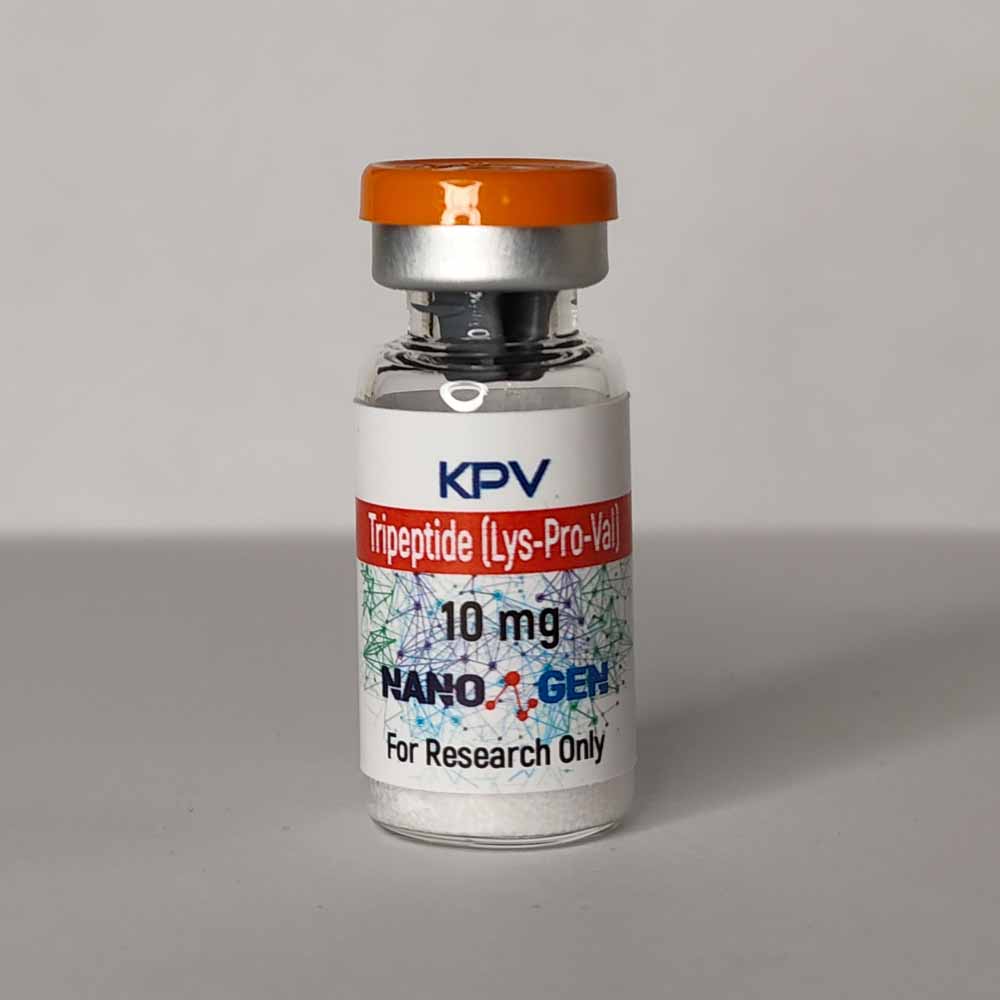
KPV: what kind of peptide it is and why scientific interest in it is growing
KPV is a short peptide that has been increasingly discussed in the scientific community in recent years as a promising molecule for the study of inflammation, tissue repair, and the protection of mucosal surfaces. Despite its very small size, KPV has attracted researchers’ attention because it is capable of demonstrating biological activity characteristic of larger regulatory peptides. That is why it is viewed not as a random compound, but as an interesting fragment with its own research potential.
What is KPV
KPV is a tripeptide consisting of only three amino acids: lysine, proline, and valine. The name KPV is formed from the first letters of these amino acids in international notation: Lys-Pro-Val. Despite its simple structure, this molecule is associated with important biological processes, primarily with the regulation of the inflammatory response.
Particular interest in KPV is linked to the fact that it represents a short fragment of the larger peptide α-MSH, which is involved in a number of physiological reactions in the body. Scientists have long noticed that some small segments of large molecules can retain their useful activity. In the case of KPV, this became the starting point for further research.
How interest in KPV emerged
Interest in KPV did not arise by chance. Researchers studying α-MSH and its biological effects noticed that certain short fragments of this molecule could also influence inflammation. Over time, it became clear that KPV was one of the most interesting such fragments. It turned out to be small enough to be conveniently synthesized and modified, while still retaining significant biological activity.
This led to growing interest in several directions at once. On the one hand, KPV began to be studied as an independent anti-inflammatory peptide. On the other hand, it started to be viewed as a convenient basis for creating new delivery forms: gels, capsules, nanoparticles, and local systems for the skin, intestine, and mucosal tissues.
Main characteristics of KPV
The main feature of KPV is its compactness. It is a very small peptide, and this is both its advantage and its limitation. The advantage is that short peptides are usually easier to synthesize, purify, and incorporate into various pharmaceutical forms. In addition, a small molecule is easier to integrate into modern targeted delivery systems.
However, this compactness also has a downside. Short peptides may be less stable in biological environments, may be broken down more quickly by enzymes, and may not always reach the target tissue effectively in free form. That is why the field around KPV is developing not only in terms of its biological activity, but also in terms of improving stability, protecting it from degradation, and directing its delivery to the site of inflammation.
From the point of view of scientific interest, KPV is valuable because it combines several important qualities: short length, biological relevance, a connection with a natural regulatory peptide, and promise for local application.
Which properties of KPV are studied most often
KPV is most often considered as a peptide with anti-inflammatory potential. In studies, it is associated with the ability to soften the inflammatory response, reduce the activity of certain pro-inflammatory signaling pathways, and decrease the severity of tissue damage caused by inflammation.
In simple terms, KPV is interesting to scientists as a molecule that may help the body respond less aggressively to irritation, infection, or injury. This does not mean that it completely shuts down immunity. Rather, it points to a more subtle regulation of inflammation in which an excessive reaction that can itself damage tissues is reduced.
KPV is also studied in the context of tissue barrier function. This is especially important for the intestine, the skin, the cornea of the eye, and mucosal surfaces. When the protective barrier is weakened, inflammation becomes stronger and recovery becomes slower. That is why molecules that both reduce inflammation and support barrier restoration attract major interest.
Proposed mechanisms of action
The mechanism of action of KPV cannot yet be reduced to one simple scheme. According to preclinical studies, its effect may be linked to an influence on key inflammatory cascades, oxidative stress, and cellular signals involved in tissue damage. In different models, the influence of KPV on the regulation of pro-inflammatory cytokines and intracellular pathways that trigger and maintain inflammation has been discussed.
It is important to understand that KPV does not have one universal mechanism. In one tissue, it may act primarily as an anti-inflammatory modulator; in another, as a factor supporting restoration of barrier function; and in a third, as a component of a complex system that enhances healing. That is why KPV is of interest not only as an individual molecule, but also as part of broader biomaterials and delivery systems.
KPV and inflammatory bowel disease
One of the most actively studied directions is the use of KPV in models of inflammatory bowel disease. In this field, the short peptide has shown itself to be an interesting candidate for the study of local control of inflammation. Scientists associate this with the fact that an inflamed intestine requires not only suppression of an aggressive immune response, but also restoration of the mucosal lining, intercellular junctions, and the normal barrier.
In a number of studies, KPV has been considered as a molecule capable of reducing the severity of inflammatory processes in the intestine and supporting more favorable conditions for tissue recovery. It is especially important that targeted delivery technologies for KPV began to develop in this area so that the peptide would not degrade too early and would reach the inflamed section of the colon specifically.
It was intestinal research that became one of the reasons why KPV began to be taken seriously as a promising platform for the development of new local and targeted forms.
The use of KPV in dermatology
Another important area of interest is the skin. In dermatological and regenerative research, KPV is considered as a peptide that may reduce inflammatory irritation, support tissue repair, and potentially improve the condition of damaged skin. Directions related to irritation, inflammatory reactions, healing, and protection of cells from oxidative stress are of particular interest.
The skin constantly encounters external damaging factors: air pollution, ultraviolet radiation, mechanical irritation, dryness, inflammatory reactions, and microbial burden. That is why molecules that can both reduce inflammation and support natural recovery always attract increased interest.
In practical terms, this means that KPV is considered as a possible component of gels, serums, hydrogels, and other local forms intended for the care of damaged or irritated skin. At this stage, this remains a scientific and preclinical direction, but the logic of such use is quite clear.
KPV in wound healing and tissue repair
The topic of wound healing is closely related to inflammation. When tissue is damaged, the body needs an inflammatory response, but if that response becomes too strong or too prolonged, the recovery process slows down. That is why peptides that help make inflammation more controlled are considered potentially useful for tissue repair.
KPV is studied as part of various wound coverings, biomaterials, and hydrogels. What matters here is especially its ability to work not alone, but in combination with carriers that keep the active substance in the damaged area. This approach makes the application more logical: the peptide does not simply contact the surface, but remains in the required place longer and acts locally.
This is important for science because modern regenerative technologies increasingly rely on a combination of a biologically active molecule and a well-designed delivery system.
KPV research for mucosal surfaces
Mucosal surfaces are another area where KPV generates major interest. This includes the oral cavity, the intestine, the ocular surface, and other tissues where inflammation is often accompanied by pain, irritation, and impaired barrier function. Under such conditions, gentle local approaches that help reduce inflammation and support recovery without aggressive intervention are especially valuable.
KPV is studied as a component of mucoadhesive systems, meaning forms capable of remaining on the mucosal surface. This matters because standard solutions and gels are often washed away quickly, and the peptide may not have enough time to demonstrate its activity. When the molecule is retained on the damaged surface, its effect may become more pronounced and longer lasting.
Such approaches are especially interesting for conditions in which the mucosa is damaged due to inflammation, irritation, or aggressive treatment.
KPV and ophthalmic research
The surface of the eye is a very delicate tissue that quickly reacts to inflammation, dryness, and mechanical damage. That is why ophthalmology has long shown interest in gentle local agents capable of supporting epithelial recovery and reducing irritation. In this context, KPV is considered a promising molecule for the study of local application on the ocular surface.
Interest in this direction is linked to the fact that the cornea and conjunctiva require careful restoration. Any prolonged inflammation may slow epithelialization and worsen the quality of healing. That is why even a small peptide with local anti-inflammatory potential appears scientifically significant here.
The antimicrobial potential of KPV
A separate area of interest is the possible antimicrobial activity of KPV. The scientific literature has discussed that KPV and related fragments may show activity against certain microorganisms. This is especially important in the context of wounds, mucosal tissues, and inflamed skin, where infection and inflammation often go hand in hand.
For researchers, the value here lies not only in antimicrobial activity itself, but also in the combination of several effects within one molecule. If a peptide helps restrain inflammation, supports healing, and at the same time lowers the risk of microbial burden, this makes it an especially attractive component for local biomaterials and coatings.
Why KPV is interesting for modern delivery systems
Today, not only the active molecule matters, but also the way it reaches the target tissue. That is why delivery systems around KPV are being actively developed: nanoparticles, protective capsules, mucoadhesive forms, hydrogels, and other platforms. This helps solve several tasks at once: protecting the peptide from early degradation, increasing the time of its contact with tissue, and improving local effectiveness.
This is especially relevant for short peptides. Without a suitable formulation, even a biologically active molecule may lose a significant part of its potential. With well-designed delivery, however, its properties are revealed much more effectively. That is why modern science often considers KPV not in isolation, but together with a carrier that makes its application more realistic.
Does KPV have prospects beyond one field
Yes, and this is one of the most interesting aspects of its study. KPV is not limited to a single discipline. It is being investigated in gastroenterology, dermatology, regenerative medicine, ophthalmology, biomaterials, and related fields. Such interdisciplinary interest usually arises only when a molecule truly demonstrates useful properties in different types of tissues.
But it is important to understand the difference between scientific interest and ready clinical application. A large number of studies in different areas points to potential, but does not mean that the question has already been fully resolved. Science around KPV is actively developing, yet much of it still belongs to preclinical models and experimental systems.
Limitations and an honest scientific view
When it comes to peptides, it is very important to separate real scientific data from exaggeration. In the case of KPV, there are indeed strong reasons for interest, but one should not pretend that it is already a fully confirmed and widely implemented clinical solution. The bulk of KPV-related data still comes from laboratory and preclinical research.
This is not a disadvantage, but a normal stage of the scientific path. First, a molecule is studied in cells, then in animal models, then delivery forms are developed, stability and safety are assessed, and only after that can one speak about more serious clinical prospects. Therefore, it is most accurate to describe KPV as a promising research peptide with clear interest in the field of inflammation control and tissue repair.
How KPV differs from many other peptides
The main difference of KPV lies in the combination of simplicity and functionality. It is a very short molecule that does not look particularly impressive at the level of its formula, yet such compounds often turn out to be especially valuable for science. KPV is convenient to study, suitable for chemical modification, fits well into modern pharmaceutical technologies, and at the same time is connected to a clear biological logic.
In addition, KPV is interesting because it is studied not as a stimulator at any cost, but precisely as a subtle modulator of inflammatory processes. This makes it scientifically more attractive and distinguishes it from many substances around which too many loud but poorly supported promises are built.
Conclusion
KPV is a short tripeptide that has become an object of serious scientific interest due to its presumed anti-inflammatory, barrier-supporting, and reparative properties. It is studied as a fragment associated with α-MSH and considered in the context of inflammatory bowel disease, dermatology, wound healing, restoration of mucosal tissues, local biomaterials, and modern delivery systems.
The main value of KPV lies in the fact that even a very small molecule can exert a noticeable biological effect if it acts on important mechanisms of inflammation and tissue recovery. That is why KPV continues to attract the attention of researchers from different fields. At the current stage, it is above all a promising research peptide around which an increasingly substantial and interesting scientific base is being formed.
FAQ: KPV properties, features, and applications in research
What is KPV and what are its main properties?
KPV is a short tripeptide made of lysine, proline, and valine. The main properties of KPV discussed in scientific literature include potential anti-inflammatory activity, interest in supporting barrier tissues, and involvement in local repair processes of damaged surfaces.
Which properties of the KPV peptide are studied most often?
The properties of the KPV peptide are most often studied in the context of inflammation control, protection of mucosal surfaces, support for the skin, intestinal barrier function, and local repair processes. Its role in delivery systems is also being explored, especially where the stability of short peptides matters.
Why is KPV considered a promising peptide?
KPV is considered promising because even a very small molecule can demonstrate meaningful biological activity. Researchers are especially interested in KPV in the fields of inflammation, mucosal tissues, skin, and modern localized delivery systems.
Does KPV have anti-inflammatory properties?
Yes, its potential anti-inflammatory properties are considered the main direction of KPV research. In scientific studies, it is associated with a milder regulation of inflammatory responses and a reduction in tissue damage linked to inflammation.
Can KPV be considered a peptide for tissue repair?
KPV is often viewed as a research peptide that may be relevant in the field of tissue repair, especially where regeneration is impaired by inflammation. For this reason, it is studied for the skin, mucosal tissues, the intestine, and local coverings for damaged surfaces.
Which KPV properties are relevant for the skin?
For the skin, KPV is of interest primarily as a peptide that may help reduce inflammatory irritation, support tissue repair, and protect cells from external stress factors. This is why KPV is often considered for use in gels, hydrogels, and other localized formulations.
Why are KPV properties often linked to the intestine?
KPV properties are often linked to the intestine because one of the key areas of research involves local inflammation, barrier function, and restoration of the intestinal lining. In this context, KPV is seen as an interesting molecule for targeted delivery to inflamed areas.
Does KPV have barrier-supporting properties?
Yes, KPV is being studied as a peptide with potential barrier-supporting properties. Scientific interest is linked to the fact that support for barrier tissues is important for the skin, the intestine, and mucosal surfaces, especially during inflammation and irritation.
How is KPV different from other short peptides?
The main difference is its very compact structure and its connection to an α-MSH fragment. Because of this, KPV is interesting not only as a separate molecule but also as a convenient candidate for localized formulations where small size, biological relevance, and compatibility with delivery systems are important.
Are the properties of KPV studied for mucosal surfaces?
Yes, the properties of KPV are actively studied for mucosal surfaces. Of particular interest are directions related to inflammation, irritation, local repair, and retention of the active molecule on tissue surfaces through mucoadhesive systems.
Does KPV have antimicrobial properties?
The scientific literature discusses a possible supportive antimicrobial potential of KPV, but the main interest in it is related primarily to inflammation control, support of barrier tissues, and repair processes. For this reason, the antimicrobial properties of KPV are usually described carefully and without exaggeration.
Why are gels, hydrogels, and other delivery forms important for KPV?
Gels, hydrogels, and other delivery forms are important for KPV because short peptides may be less stable in their free form. Local delivery systems help keep the molecule in the desired area for longer and make the study of its properties more practical.
Can we say that the properties of KPV are fully clinically confirmed?
No, that would not be accurate at this stage. Much of the available information on KPV properties comes from laboratory and preclinical data, so it is more appropriate to describe it as a promising research peptide rather than a fully confirmed clinical solution.
In which areas do the properties of KPV attract the most interest?
The properties of KPV attract the most interest in the areas of inflammatory processes, intestinal barrier function, skin, mucosal surfaces, local regeneration, and modern delivery systems. These are the directions most often discussed in scientific papers and reviews.
Who may be interested in information about KPV properties?
Information about KPV properties may be useful for those studying research peptides, inflammation, barrier tissue function, local repair, and modern biomaterials. For a website, this kind of information works well as an educational SEO block without excessive promises or promotional claims.