
GLOW
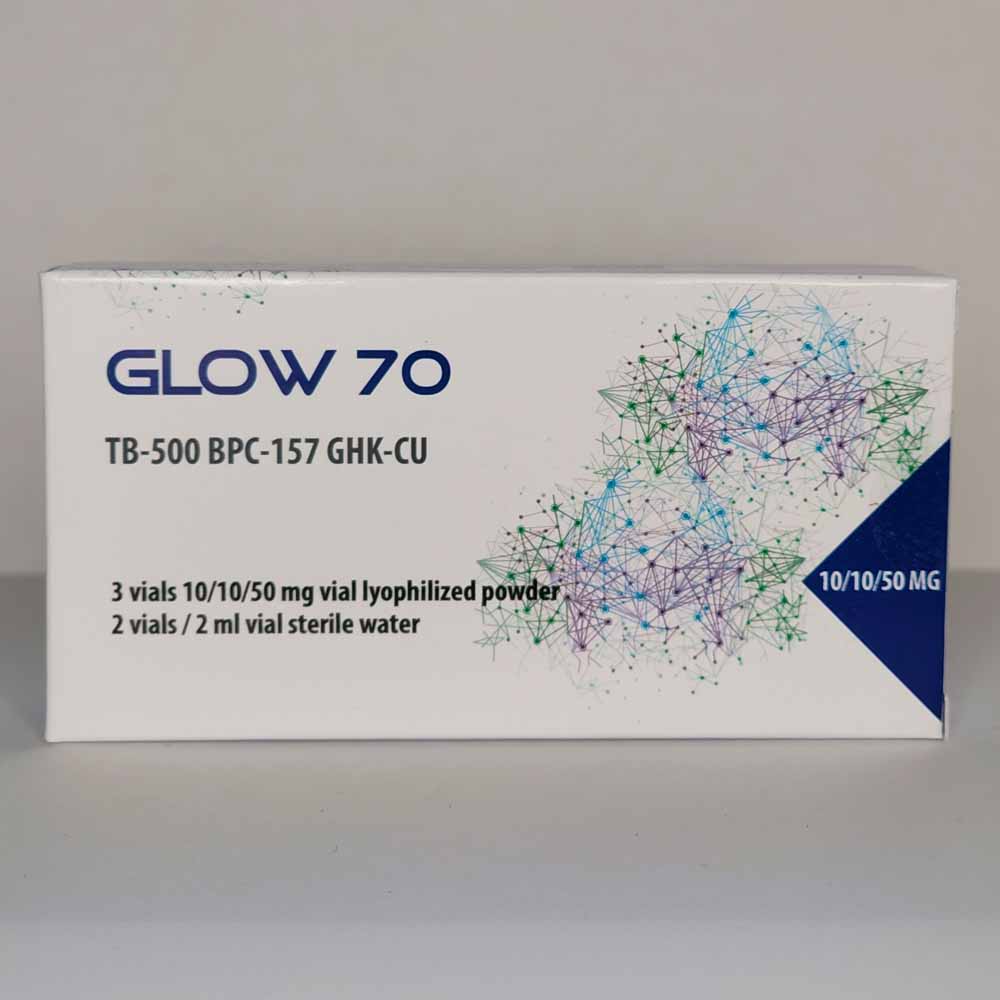
GLOW Peptide Complex: Composition, Properties, Effects, and Use in Cosmetology
The GLOW peptide complex is usually considered a combination of several components brought together in one formula to work on skin quality, its appearance, and its restorative potential. In the cosmetology context, GLOW is most often associated with improved skin texture, a more even tone, a feeling of density, visual facial freshness, and the overall effect of well-cared-for, more vibrant skin. Interest in this complex is linked not only to its fashionable name, but also to the very idea of combining several peptide directions in one system, each of which has long been discussed in the aesthetic field on its own.
GLOW is not perceived as a single ingredient, but as a complex peptide product. That is exactly where its logic lies: not a point-targeted effect on one issue, but an attempt to work in several directions at once that matter for the skin. That is why any discussion of GLOW is always broader than the description of one substance. It is important to understand both the composition, the properties of the individual components, and the overall effect expected from their combination.
The History of GLOW
The history of GLOW is connected with the growing interest in peptides in cosmetology and in aesthetically oriented restorative protocols. For a long time, specialists were drawn to individual peptides linked to tissue renewal, support of skin structure, improvement of visible skin quality, and restorative processes. Gradually, it became clear that skin rarely needs only one effect. In reality, it often needs texture improvement, density support, recovery after stress, and work on signs of fatigue at the same time.
This logic is exactly what led to the idea of the GLOW complex. Instead of relying on just one component, the GLOW concept combines several peptides in one product. This approach turned out to be especially interesting for cosmetology because it made it possible to look at the skin not only from the perspective of surface care, but also as a tissue whose condition depends on many processes at once. GLOW began to be perceived as a more modern and more cohesive formula for situations where a narrow effect is not enough and a broader aesthetic approach is needed.
Over time, the name GLOW itself became associated with the effect of radiant, even, fresh, and visibly higher-quality skin. But behind this name there is not only a visual idea. At the core is the combination of peptide ingredients, each of which contributes to the overall profile of the complex.
What Is GLOW
GLOW is a peptide complex used in an aesthetic and cosmetology framework as a composition focused on improving skin quality, supporting visible freshness, visual density, and restorative processes. It is perceived as a solution for skin that is no longer satisfied with ordinary basic care alone. First of all, GLOW becomes relevant when the face looks dull, tired, dehydrated, less firm, or visually depleted.
The main feature of GLOW is that it is not valued for one narrow effect. It is interesting precisely as a complex associated with several directions at once: anti-age support, a more even texture, improvement of overall tone, the feeling of more collected skin, and a restorative cosmetology logic. That is why GLOW is often seen as a more complete concept than separate products based on a single active component.
What the GLOW Peptide Complex Consists Of
The most common description of the GLOW peptide complex includes three main components:
- GHK-Cu — a copper peptide widely known in cosmetology and skin care products.
- BPC-157 — a peptide associated with restorative tissue support.
- TB-500 — a peptide considered in the context of regenerative processes and tissue dynamics.
This composition forms the core idea of GLOW. It is not just a set of popular names, but a combination of ingredients with different functional accents. One component is linked to skin quality and structural support, the second to restorative processes, and the third to regenerative tissue activity. It is this combination that makes GLOW perceived as a complex aesthetic product.
A Brief Overview of Each Ingredient in the GLOW Peptide Complex
GHK-Cu
GHK-Cu is a copper peptide that has long held a special place in cosmetology. It is often associated with improved visible skin quality, a more even texture, support of collagen and elastin, and a visually rejuvenating effect. GHK-Cu is often perceived as one of the most “aesthetic” peptides in the formula because it is associated with skin that looks fresher, denser, and more collected.
Within the GLOW complex, GHK-Cu plays an important role because it is this component that forms the strongest connection between the formula and skin care in anti-age logic. For many people, this is exactly what makes GLOW interesting in cosmetology not only as a restorative complex, but also as a product aimed at visibly improving skin quality.
BPC-157
BPC-157 is usually associated with restorative processes and tissue support. In the context of GLOW, it matters as part of the overall restoration logic. If the skin is dealing with stress, dryness, external aggression, irritation, or a slow return to a normal appearance after strain, these are exactly the kinds of components that make the complex broader in action.
In the GLOW formula, BPC-157 is not perceived as a separate “star,” but as a peptide that strengthens the overall restorative direction of the complex. It makes the formula less narrow and helps create a more complete impression of the product as a system for the skin rather than simply a tool for a superficial aesthetic effect.
TB-500
TB-500 is usually viewed as a component associated with regenerative activity and restorative tissue dynamics. In cosmetology logic, it is especially interesting where the skin appears weakened, less elastic, visually exhausted, or in need of deeper support.
In the GLOW formula, TB-500 serves as the component that complements and strengthens the overall idea of the complex. If GHK-Cu is perceived as the peptide for skin quality and BPC-157 as part of restorative support, then TB-500 completes the composition with an emphasis on tissue-oriented regenerative direction. That is why GLOW is seen as something more than just the sum of its ingredients.
Positive Properties and Effects of GLOW
Interest in GLOW is connected to the fact that this complex is usually viewed as a multi-level solution for the skin. Among the most commonly mentioned positive properties and effects are:
- improvement in the overall appearance of the skin;
- a more even and fresher facial tone;
- reduction in the impression of dull and tired-looking skin;
- support for a denser and visually more collected texture;
- a feeling of greater skin elasticity;
- softening of the visible expression of minor age-related changes;
- support of restorative processes;
- interest within anti-age cosmetology;
- an increase in the overall aesthetic attractiveness of the skin;
- a more cared-for and more vibrant appearance of the face.
The main strength of GLOW is that it is not reduced to a single advertising promise. It is not only about glow, not only about density, and not only about restoration. The complex is interesting precisely because it combines several directions in one formula and, because of that, is perceived as a fuller aesthetic product.
Side Effects of GLOW
Although GLOW is usually discussed through its potential positive properties, the issue of tolerance and possible side effects is also important. As with other active peptide formulas, much depends on individual sensitivity, the quality of the specific product, the characteristics of the skin, and the general cosmetology background.
Possible unwanted manifestations usually include:
- individual intolerance to certain components;
- local irritation;
- redness;
- increased skin sensitivity;
- an unwanted reaction in very reactive skin;
It is also important to consider that active peptide complexes require a careful approach. The more sensitive, stressed, or overloaded the skin is, the greater the importance of a balanced and thoughtful strategy. That is why the side effects of GLOW are more often associated not with the idea of the complex itself, but with an individual reaction, incorrect product selection, or the questionable origin of the formula.
Use of GLOW in Cosmetology
In cosmetology, GLOW is interesting as a complex for skin that no longer responds fully to ordinary care solutions. It is considered when the skin is not simply dry or dull, but appears less resourceful overall: density decreases, the face begins to look tired, texture worsens, the skin loses its sense of firmness, and starts to be perceived as more aged or exhausted.
One of the main directions of GLOW use is anti-age cosmetology. Here the complex is interesting because it is associated not with one narrow action, but with the overall support of skin quality. When the face starts to look less firm, the texture becomes less even, visible dryness increases, and the overall tone loses freshness, this is exactly the type of complex that becomes especially in demand. In this logic, GLOW is seen as an option for improving the overall aesthetic perception of the skin.
Another important area of use is restorative cosmetology. The modern approach to skin care has long gone beyond simple cleansing and hydration. Today, a lot of attention is paid to how the skin recovers after stress, seasonal dryness, environmental exposure, active procedures, and chronic fatigue. GLOW fits naturally into this philosophy because its formula is associated specifically with supporting the skin at times when it needs more than simple cosmetic comfort.
GLOW is especially interesting for dull skin. There is a type of condition in which the face does not look obviously problematic, yet constantly gives the impression of fatigue: the tone seems uneven, the skin reflects light worse, visually loses liveliness, and becomes less expressive. In such cases, GLOW is seen as a complex for fuller aesthetic support, where not only a surface effect matters, but also the attempt to improve the general perception of skin quality.
GLOW is also discussed in the context of skin with signs of reduced density. This is especially relevant when the face begins to look softer in contour, the skin appears thinner, less elastic, and less able to hold overall tone. In such cases, the value of the complex lies in the fact that it is associated simultaneously with structural support, restorative logic, and visual texture improvement.
In cosmetology practice, it also matters how comfortably a product is perceived as a unified concept. GLOW looks attractive in this respect because it combines several directions in one formula. Instead of considering each component separately, the complex offers a ready aesthetic logic: improving skin quality, supporting visible freshness, working on the feeling of fatigue, and delivering a more collected visual result.
GLOW also looks relevant for skin experiencing external stress. Urban environments, dry air, seasonal changes, lack of sleep, chronic stress, and the general pace of life strongly affect the appearance of the face. Even without pronounced age-related changes, the skin may look visually depleted. In such a situation, complexes like GLOW attract attention precisely because they are positioned as broader support rather than a product for solving one isolated issue.
Another important aspect of GLOW use in cosmetology is the combination of aesthetics and the restorative idea. This is one of those cases where the product is interesting not only because of the promise of “glow,” but also because its whole image is built around better-quality skin. Not around a dense masking effect, but around the feeling that the skin looks better overall: more alive, more even, more collected, fresher, and more aesthetically appealing.
For many people, that is exactly what makes GLOW a noticeable product in the field of cosmetology. It is seen not as just another skin care name, but as a complex with a clear logic: support the skin, improve its visual quality, and help it look less tired and more resourceful. That is why the use of GLOW is more often associated not with a one-time task, but with an aesthetically oriented approach to overall skin condition.
FAQ
What is the difference between GLOW and the products it consists of if they are used separately?
The main difference of GLOW is its complex logic. When the components are used separately, each of them is perceived as an independent direction with its own role and its own focus. GLOW combines them into one system where what matters is not the separate effect of each ingredient, but the overall result. This approach is especially interesting in cosmetology because skin rarely needs only one action. Much more often, it needs support of quality, restoration, and aesthetic improvement at the same time.
What advantages does GLOW have over the individual components?
The advantages of GLOW are most often associated with convenience, wholeness, and synergy. Instead of three separate products or three separate directions, the user gets one complete formula. This is easier to understand and easier to integrate into the overall cosmetology logic. In addition, the complex looks more complete from an aesthetic point of view: not scattered actions, but one shared direction toward improving skin quality, supporting restoration, and achieving a fresher appearance.
Why is GLOW considered a more convenient solution?
Because with a complex formula there is no need to assemble a scheme from separate components on your own. GLOW is perceived as a ready concept. This is convenient both for understanding the product and for seeing its role in cosmetology care. That is why many people find it easier to focus on one complex rather than on several separate positions, each requiring its own attention.
Can GLOW be purchased with delivery across Ukraine?
For a commercial page, it is logical to indicate the possibility of purchasing GLOW with delivery across Ukraine. The clearest and most natural format for an FAQ section is to mention major delivery destinations such as Kyiv, Kharkiv, and Odesa. This immediately answers a common practical customer question and makes the page more useful for a real purchase.
Is delivery of GLOW available to Hungary, the Czech Republic, Slovakia, and Poland?
In the FAQ section of a commercial page, it is appropriate to indicate that GLOW can be purchased not only with delivery across Ukraine, but also to Hungary, the Czech Republic, Slovakia, and Poland. Such a block makes the page more complete and more useful for buyers looking for international shipping.
For what type of skin does GLOW usually attract the greatest interest?
Most often, GLOW is of interest to those dealing with a dull complexion, the feeling of tired skin, reduced density, visible loss of freshness, a less even texture, and the overall impression that the skin lacks resources. It is exactly within this logic that the complex reveals itself most naturally.
Conclusion
The GLOW peptide complex is a complete aesthetic concept based on the combination of GHK-Cu, BPC-157, and TB-500. Interest in it is explained not only by the name and not only by the individual properties of the components, but by the very idea of combining several directions important for the skin within one formula. That is exactly why GLOW is associated with improved skin quality, visible freshness, a more collected texture, and restorative support.
In cosmetology, GLOW is perceived as a product for skin that needs more than just basic care. Its logic is built around a better appearance, anti-age direction, work on dullness, density, and the overall aesthetic appeal of the face. Because of its complex nature, GLOW does not look like just another isolated ingredient, but like a more complete solution that is interesting both from a care perspective and from the perspective of overall cosmetology strategy.