
History of Peptide Discovery
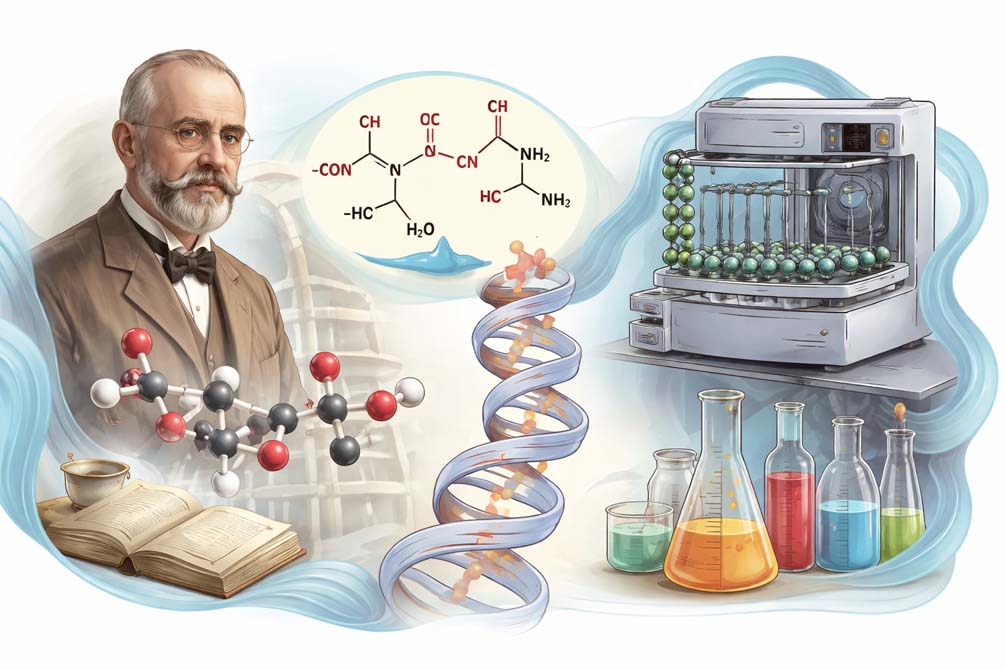
History of Peptide Discovery
History of Peptide Discovery: What Peptides Are, the Peptide Bond, and Peptide Synthesis
The history of peptide discovery is a journey from early guesses about the nature of proteins to modern biochemistry, where the peptide bond and peptide synthesis have become fundamental concepts. To clearly understand what peptides are, it is helpful to see how the idea of amino acid chains developed and why peptides are now considered one of the key subjects of scientific research.
What Are Peptides in Simple Terms?
What are peptides? Peptides are chains of amino acids linked together by chemical bonds. These bonds are called peptide bonds. Unlike large proteins, peptides are usually shorter, yet they can perform important signaling and regulatory functions. That is why searches such as “what are peptides” remain consistently relevant: peptides participate in many biological processes and are often regarded as independent active molecules.
19th Century: Proteins as a Mystery and the First Steps Toward Structural Understanding
In the 19th century, proteins were already known to scientists, but their structure remained unclear. Proteins were viewed as complex substances without a defined organization. Biochemistry was only beginning to emerge, and the understanding that proteins and peptides could be built from repeating units — amino acids — developed gradually.
The Peptide Bond: The Key to the Amino Acid Chain Model
A turning point came with the concept of the peptide bond. A peptide bond is an amide-type bond formed between the carboxyl group of one amino acid and the amino group of another. This discovery clarified that amino acids can link into linear chains, and these chains can form larger structures.
- The peptide bond explained how amino acid chains are formed.
- The amino acid sequence came to be viewed as the foundation of a molecule’s properties.
- A clear chemical model emerged explaining what peptides are and how they relate to proteins.
20th Century: Peptides as Independent Signaling Molecules
In the 20th century, research showed that peptides are not merely “fragments” of proteins. Gradually, it became clear that what peptides are in biological terms often means independent molecules that act as signals and regulators. This led to a deeper understanding of hormonal peptides, neuropeptides, and other regulatory compounds.
These discoveries transformed the view of cellular communication: it became evident that peptides can trigger cascades of reactions and influence intracellular processes by interacting with receptors.
Peptide Synthesis: A Technological Revolution
The next decisive stage was the development of technologies that made controlled peptide synthesis possible. Peptide synthesis enabled scientists to assemble amino acid chains step by step, forming a new peptide bond at each stage. This turned peptides into a convenient research tool: molecules could now be obtained reproducibly and predictably.
- The chain is built step by step: one amino acid at a time.
- A new peptide bond is formed at each step.
- It becomes easier to control the purity and quality of the resulting compound.
- Peptide synthesis expanded the possibilities of laboratory science and biochemistry.
Why the History of Peptide Discovery Matters Today
Understanding what peptides are, how the peptide bond is structured, and why peptide synthesis became a breakthrough helps navigate modern biochemistry and molecular biology. Today, peptides are regarded as precise tools for studying cellular mechanisms, modeling molecular interactions, and advancing peptide engineering.